April 29, 2026
 Washington, D.C. | Online
From Barriers to Opportunities: Leveraging Standards in Africa’s Agrifood Systems
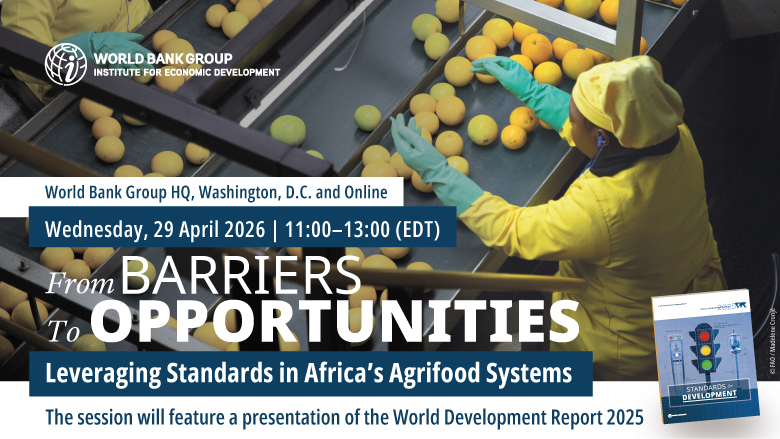
Standards shape how economies function—often behind the scenes, but with far‑reaching consequences. From food safety and plant health to sustainability, labor practices, and traceability, standards determine who can access markets, compete effectively, and move up the value chain. As highlighted in the World Development Report 2025: Standards for Development (WDR 25), nearly 90 percent of global trade is affected by non‑tariff measures linked to standards, making them a critical part of the “hidden infrastructure” that underpins productivity, trade, and inclusion.
The Institute for Economic Development organized the event From Barriers to Opportunities: Leveraging Standards in Africa’s Agrifood Systems, which brought together World Bank Group experts and partners to discuss the implications of the WDR 25 report for agrifood systems, with a particular focus on Africa.
The discussion explored:
- How standards shape trade, food safety, sustainability, competitiveness, and inclusion in agriculture, forestry, and natural-fiber value chains from input to plate.
- The specific challenges and opportunities for smallholders and SMEs in Africa
- The rationale, scope, and priorities for a potential companion report on agrifood standards
Participants in person and online from across the world joined the conversation on how standards can better support market access, competitiveness, and inclusion across agriculture, forestry, and natural‑fiber value chains.
World Bank Group Headquarters. Room MC 6-100. All times listed below are in Eastern Time (ET).
| April 29, 2026 | |
| 11:00–11:05 | Welcome Remarks Gero Carletto, Head of Rome Center, Institute for Economic Development, World Bank Group |
| 11:05-11:15 | Introduction Andrew Dabalen, Chief Economist, Africa Region, World Bank |
| 11:15–11:35 | Presentation of the World Development Report 2025: Standards for Development Key messages from the report with emphasis on agrifood systems and the impact of non-tariff measures.
|
| 11:35 – 11:40 | World Development Report 2025: Standards for Development and Africa Reflections from Andrew Dabalen, Chief Economist, Africa Region, World Bank |
| 11:40–12:30 | Panel Discussion Making standards work—operations, investment, and partnerships.
|
| 12:35–12:50 | Q&A Moderated discussion with participants. Aparajita Goyal, Lead Economist, Office of the Chief Economist, World Bank Africa Region |
| 12:50–13:00 | Closing and Next Steps Key takeaways from the discussion and closing remarks. Gero Carletto, Head of Rome Center, Institute for Economic Development, World Bank Group |
 | Gero Carletto |
 | Andrew Dabalen |
 | Xavier Gine |
 | Aparajita Goyal |
 | Chakib Jenane |
 | Jacqueline Khanali Njonjo Operations Officer, IFC |
 | Dawit Phillipos |
 | Dil B. Rahut |
 | Jo Swinnen |
 | Lucas Zavala |
The World Bank Group is currently preparing a companion report to the WDR 25 focusing specifically on agrifood systems to better understand how food safety, animal health, and phytosanitary standards affect market access, productivity, and inclusion—particularly for low- and middle-income countries and small-scale producers. We greatly welcome your insights and experience to ensure that the report is practical and useful for policymakers and practitioners.
Your feedback will help us identify priority gaps, key challenges, and areas where further analysis or guidance could support more effective implementation of standards in agrifood systems.