From Evidence to Impact: How We Are Reimagining Learning
By Francesca Spagnoli, Noemi Caiazzo, Mohammad Chatila.
What does it really take to move from knowledge to impact at a global scale?
It takes rethinking how knowledge is created, translated, and delivered so that it reaches the people who need it, when they need it, in a format they can use and retain. That is the challenge the World Bank Group Institute for Economic Development has taken on, and at this year's Worlds of Learning 2026 Virtual Summit we shared how far we've come with an audience of more than 1,500 participants.
Our learning community was built on a simple belief: that the distance between a World Bank insight and the person who needs it most should be as short as possible.
We are supporting the shift from knowledge production to actively enabling its use. We are doing this by creating partnerships, customizing knowledge, and using digital technology, like AI, to help us deliver the right knowledge to the right audience at the right time.
But how does this translate into real impact?
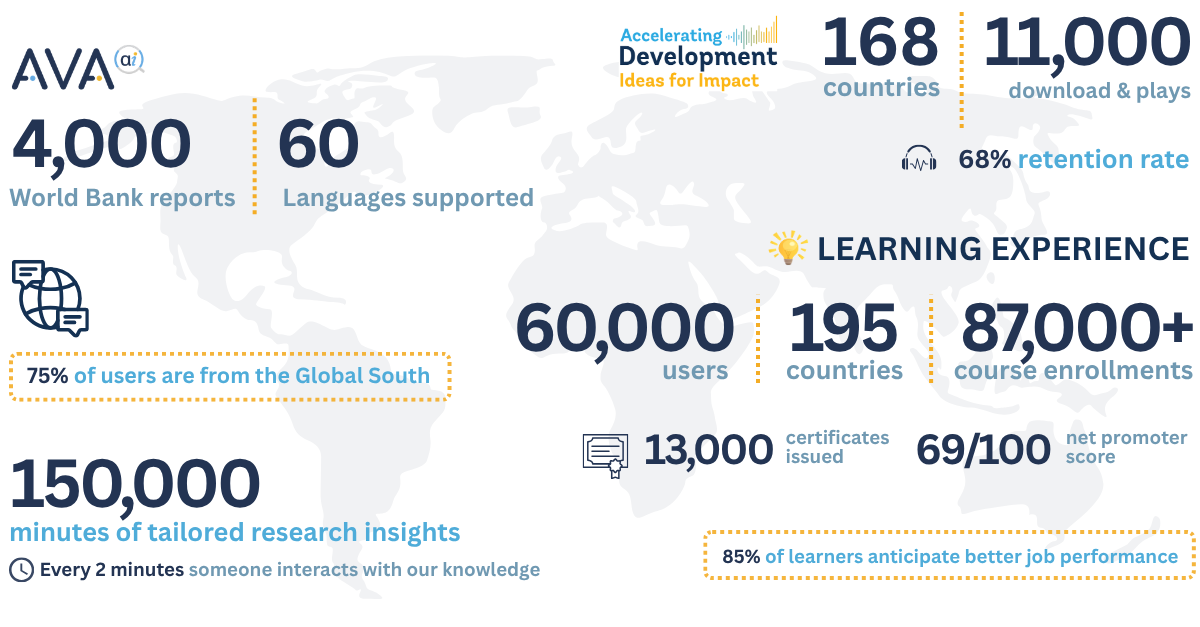
The numbers tell part of the story. In the last two years, we have had over 60,000 users engaging on our platforms from 195 countries. We registered over 87,000 course enrollments and issued 13,777 certificates. Our courses got a Net Promoter Score of 69 out of 100. But behind every metric is a person, a government official in Nairobi, a researcher in Dhaka, or a development practitioner in Rome, who came looking for knowledge and left better equipped to act on it.
This is about engagement. We are designing learning experiences that turn complex research from the World Bank Group into clear, practical, and actionable knowledge - making engagement with evidence part of everyday professional practice.
How are we doing this?
Everything changed when we asked a harder question: What if the bottleneck isn't content but it's access instead? There are thousands of World Bank reports with brilliant analysis, years of fieldwork, and peer-reviewed conclusions. And yet most of that knowledge sits behind long PDFs, in English, that take hours to process. To break language and access barriers for policy makers and researchers across the world, we developed innovative tools like AVA, an AI-research assistant trained with over 4,000 World Bank reports. AVA lets users interact with the reports and transform knowledge into mind maps, slide decks, infographics, audio recaps, and quizzes in more than 60 languages in minutes, not months.
And for practitioners on the go, we introduced the Accelerating Development – Ideas for Impact podcast. Its weekly episodes distill World Bank reports into practical, actionable takeaways in seven languages: English, French, Spanish, Hindi, Arabic, Chinese, and Portuguese. Every episode is AI-generated and human-controlled, with editorial oversight from researchers and experts at every stage.
The podcast has reached 168 countries with over 11,000 downloads and plays, with a retention rate of around 70%. For us, the message is clear: when development knowledge is made accessible and relevant, people across the globe will show up for it.
Episode with highlights from the World Bank Commodity Markets Outlook, April 2026, report.
What's next?
We're building an AI Tutor, a personalized pedagogical tool designed to adapt to individual learning needs, in any language, at any level. The future of learning at the Institute isn't just faster or bigger. It's more personal, localized, and deeply connected to the real policy questions people face every day.
We are effectively helping change the ratio of knowledge production and dissemination. For too long, the gap between analysis and engagement has been too wide. We are narrowing it with tools that save users 2 to 4 hours per week, with courses that 85% of participants say will improve their job performance and help them tackle key development challenges better, and by connecting a community that now spans virtually every country on earth.
Knowledge has always been one of the Bank's most powerful tools to generate change. At the Institute, we are building the infrastructure to deliver it at the speed and scale the world needs.
Watch our Worlds of Learning 2026 Virtual Summit presentation here to learn more: