Taking the World Development Report 2025 to Various Forums Across Japan

When Xavier Gine, Director of the World Development Report 2025: Standards for Development (WDR 2025), arrived in Tokyo in early April 2026, he brought with him a question that lies at the center of modern economic development: how can countries transform standards from technical requirements into tools for growth, innovation, and inclusion? Over three days, the World Bank Group Institute for Economic Development (IED) Tokyo Office, together with the World Bank Group Tokyo Office and partners including the Japan International Cooperation Agency (JICA), the Japanese Industrial Standards Committee (JISC), and the Japanese Association for Development Economics (JADE), convened a series of conversations that gave that question the due consideration as it pertains to the region. The IED works with a global network of think tanks, research institutions, and experts to adapt insights to local contexts, while ensuring that local researchers have a platform to contribute to global conversations — and the Japan series was a vivid expression of that mission in action.
How can countries leverage standards for development? An Academic Roundtable
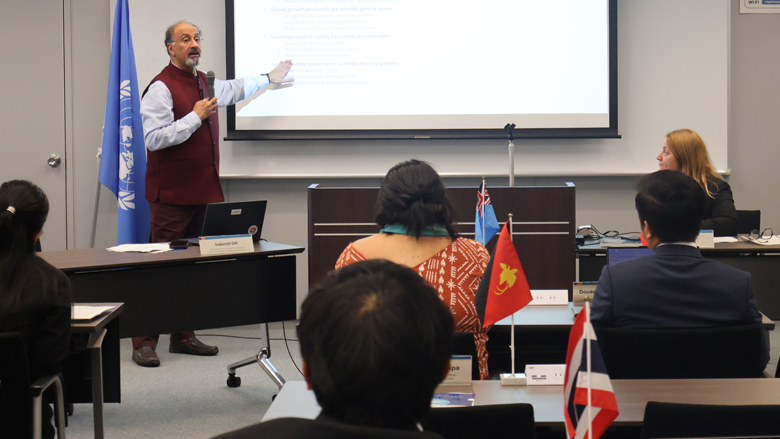
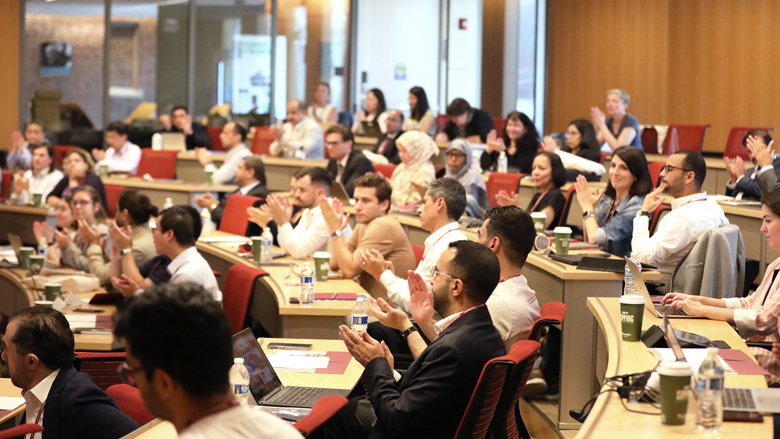
The first gathering, on the morning of April 9, brought fourteen academics from universities and research institutes across Japan to the World Bank Tokyo Office. The discussion was hybrid, drawing participants from as far as Osaka, Nagoya, Shimane, and Yokohama, and the range of disciplines — trade economics, development policy, engineering, and area studies — provided a richly textured set of perspectives.
The opening exchanges set the tone early. One participant observed that Japanese standards are frequently overlooked in international settings not because of inferior technical quality, but because the engineers who develop them often lack the English-language capacity to advocate for their adoption. In a global system where the language of standardization is largely English, technical excellence alone is not enough. Another participant pushed the conversation toward the frontier, asking how standards should apply to the ICT sector — particularly generative AI — where technology evolves faster than any committee can deliberate.
From there, the discussion opened into the central tensions of the WDR 2025 itself. Several participants argued that a gradual approach to standard-setting is essential, since developing countries often inherit standards designed by wealthier nations for wealthier contexts. The problem, as one participant noted, is that once standards are fixed, flexibility rarely follows — the political economy of the process tends toward lock-in. This raised a harder question: is it even realistic to expect genuine diversity among countries to be reflected in international standard-setting bodies? Mr. Gine of the World Bank offered an empirical counterpoint, noting that adoption rates are demonstrably higher when countries participate in the technical committees that write standards, and that some committees actively fund developing country participation to make this possible. He acknowledged, however, that the gap between what is possible and what routinely happens remains wide.
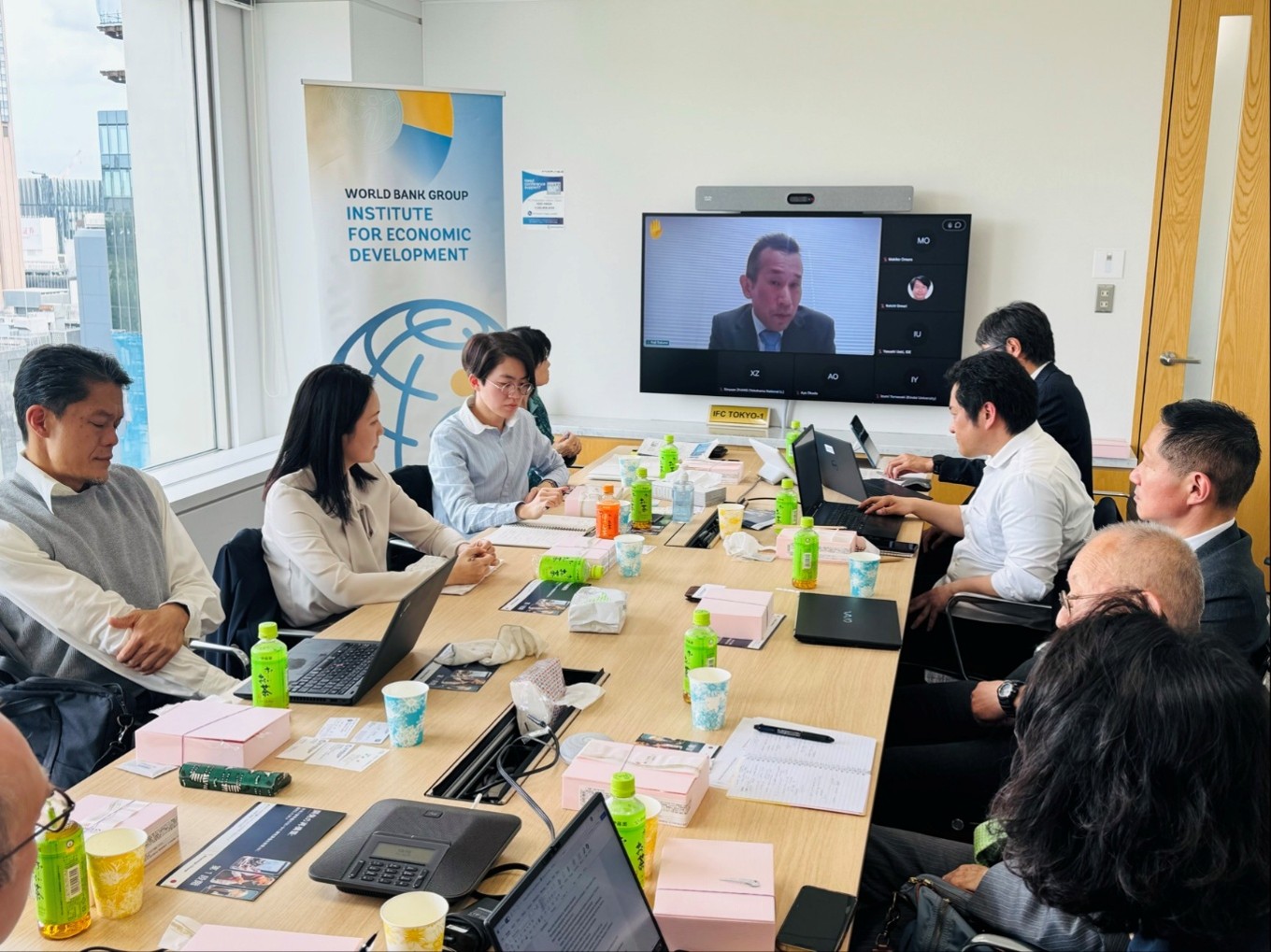
The discussion ranged across continents and sectors. One participant tied standard-setting capacity directly to market power, with the EU as the clearest example of a jurisdiction that shapes global norms through the sheer scale of what it imports. Two cautionary examples illustrated what can go wrong: the loss of competitiveness in a major consumer electronics market, attributed not to product quality but to a failure of internationalization; and a food safety crisis in which standards calibrated too high drove manufacturers toward harmful additives rather than compliance — a reminder that poorly designed standards can produce outcomes precisely opposite to their intent.
Others drew on examples closer to the ground. One participant described how ISO standards were used in India's automotive sector to build local supplier capacity, and how skill certification schemes in the EU and ASEAN have improved worker mobility across borders. A counterpoint followed: rigid technical standards can foreclose innovation by closing off alternative approaches, and the long coexistence of metric and imperial measurement systems worldwide suggests that some pluralism in standards may be inevitable, albeit costly. The geopolitical dimension was also raised — who sets standards has direct implications for supply chain resilience — while another participant pointed to a grassroots agricultural initiative in South Africa where peer-to-peer learning among farmworkers, rather than government mandate, drove standards adoption at scale.
The incentive logic running through many of these examples was perhaps most clearly illustrated by a discussion of Bangladesh's garment sector: factories exporting to the EU comply with demanding standards; those selling domestically often do not. The gap is not ignorance — it is the presence or absence of a commercial reason to comply. The session closed with a reflection on compliance costs: when safety, privacy, and liability requirements are high enough, they can exclude developing country producers from international markets entirely, regardless of their technical capability. Mr. Gine signaled that an upcoming World Bank report on agri-food standards would take up the specific question of how smallholders can be brought into high-value chains.
Inside the Standards Machine: A Conversation with JISC
That same afternoon, the conversation shifted registers entirely. At the Ministry of Economy, Trade and Industry's Annex Hall, Mr. Gine and the IED team met with senior officials from the Japanese Industrial Standards Committee — including Deputy Director General Imamura Watari and directors responsible for international affairs and standardization coordination. The session was conducted with consecutive interpretation, and what emerged was a frank account of how one of the world's most sophisticated standardization systems actually operates, and where even it struggles.
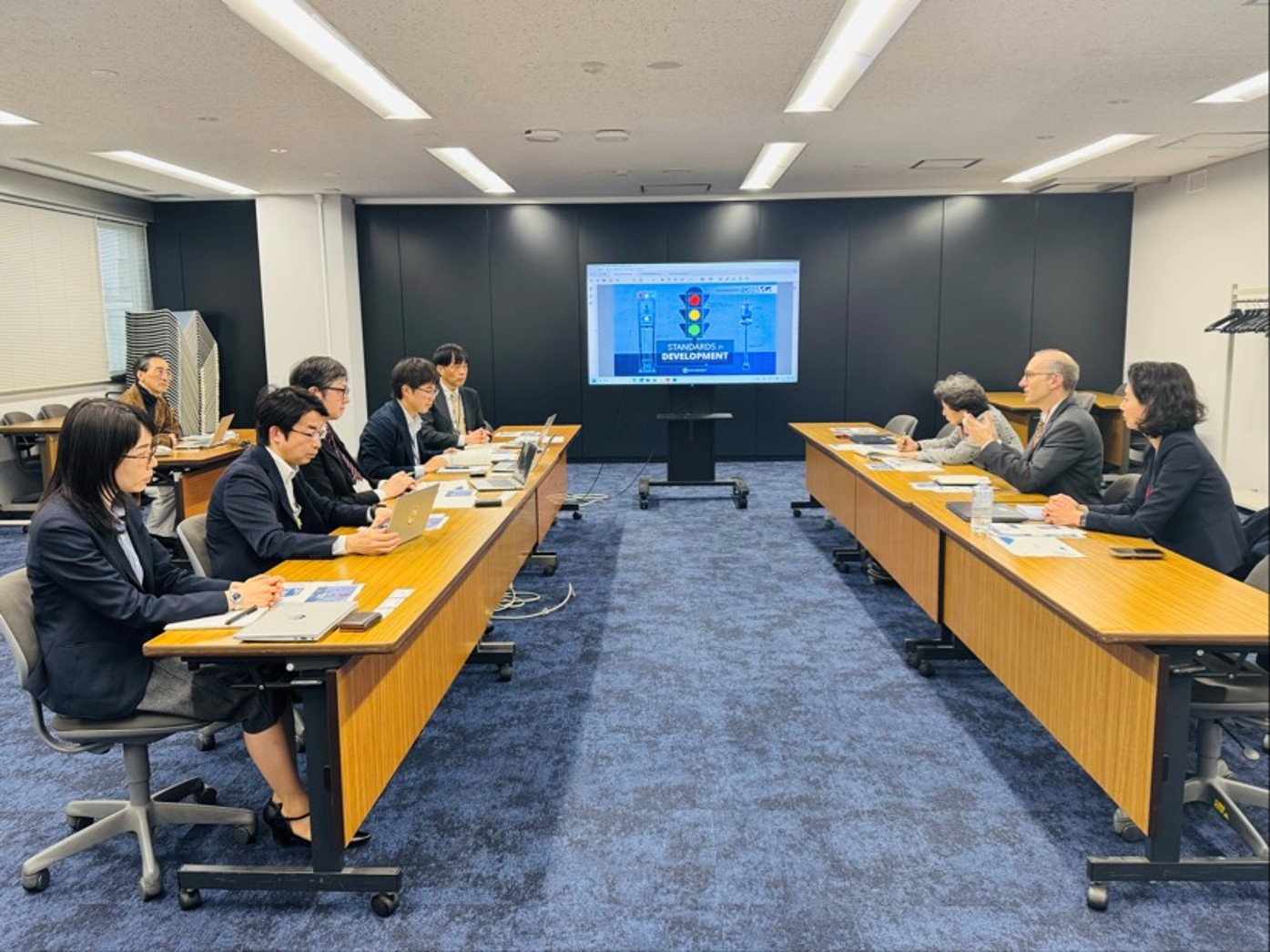
The officials were candid about the limits of their own influence. Despite Japan's impressive technical depth; approximately 11,000 JIS standards and Group A membership in the International Electrotechnical Commission, one of only six countries to hold that status, Japan's broader standardization strategy has historically been relatively weak. Political momentum has shifted recently, driven partly by the Prime Minister's framing of Japan as a technology-driven nation, but the shift is recent and fragile. JISC's high positioning within METI gives it proximity to industrial policymakers that most standard-setting bodies in other countries lack, but it also limits engagement with health, education, and agriculture Ministries where standards matter just as much.
The conversation on certification captured a tension that resonates well beyond Japan. Japanese firms exporting to Europe are required to have their products certified by European certifiers - a process that is costly, raises concerns about product information disclosure, and creates economic security risks. The ideal solution, mutual recognition of domestic certification, requires regulatory equivalence and potentially new legislation, and JISC approaches it cautiously. Underlying all of this, the officials said plainly, is a problem familiar to anyone making the case for investment in Quality Infrastructure: there is simply not enough evidence of the concrete impact of standardization on economic outcomes to make the argument compelling to finance ministries and skeptical policymakers, underlining the timeliness of the WDR 2025 that boldly and expertly takes on the subject.
Japan as a Model: The JICA Seminar
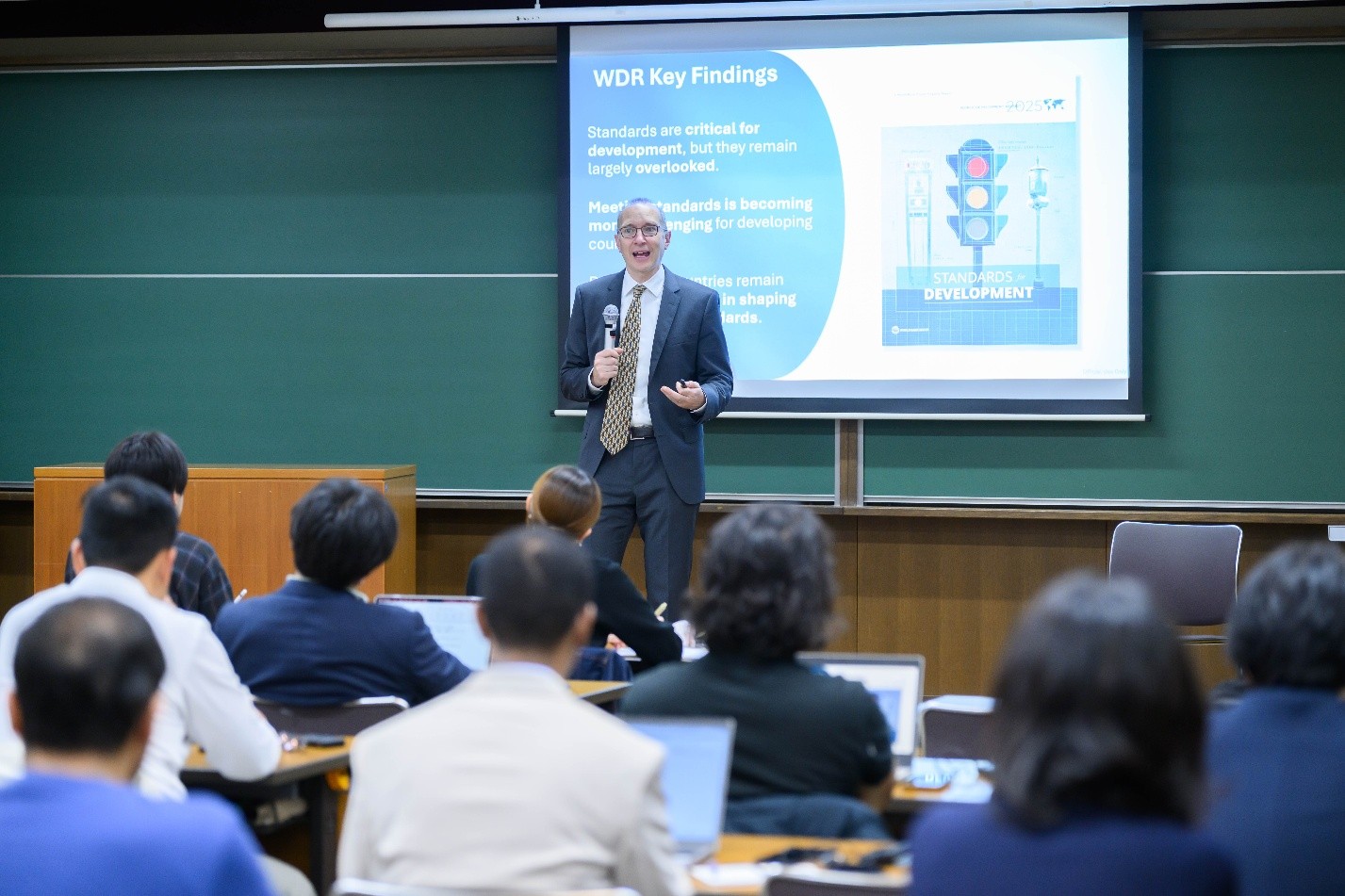
The morning of April 10 brought a different kind of perspective. At the Graduate School of Toyo Eiwa University, the IED and WBG Tokyo convened a seminar with JICA — the Japan International Cooperation Agency — that took a longer historical view. After opening remarks by Kerina Wang, the Head of the IED Tokyo Center and a presentation by Mr. Gine laying out the WDR 2025's central arguments, Senior Advisor Toru Honma drew on Japan's own development trajectory to illuminate what is at stake. Quality improvement and standardization, he explained, were not peripheral to Japan's postwar industrial rise — they were embedded in its industrial policy, bound up with quality management culture, continuous improvement, and sustained institutional capacity-building. "Creating a culture of compliance and certification," Honma said, "will ultimately contribute to the development of the country — which is what Japan did in the 1990s." Standards, in his framing, are not a compliance burden imposed from outside but a tool for building domestic capacity when taken seriously. JICA continues to transmit this experience through technical cooperation programs across Asia and beyond, making it one of the few bilateral agencies with both the institutional memory and the operational reach to translate Japan's standards history into practical support for partner countries.
From Theory to the Farm: The JADE Annual Conference
The final day placed the WDR 2025 in direct dialogue with frontier empirical research, at the annual conference of the Japanese Association for Development Economics. During a special session for the World Bank Development Economics Unit (DEC), Mr. Gine presented the report's findings, followed by commentary from two economists whose work sits squarely at the intersection of trade, agriculture, and standards.
Professor Tsunehiro Otsuki of Osaka University offered a rigorous survey of the empirical literature — and the honest assessment is that the evidence is mixed in ways that complicate easy conclusions. Trade effects vary by product: fresh vegetables and nuts tend to face negative impacts from standards, seafood shows a more varied picture. They vary by country pairing: exports from low-income to high-income countries tend to fare worst. They vary by analytical method: advanced gravity models that separate demand-enhancing from trade-cost effects tell a more nuanced story than simpler approaches. And underlying all of it is consumer willingness to pay, which sets a ceiling on any price premium that compliance might generate, and which varies enormously across income levels, demographics, and how persuasively scientific information about standards is communicated.
Professor Aya Suzuki brought the discussion to the farm level, drawing on years of research into the shrimp aquaculture sector in Southeast Asia. The picture she presented was sobering. Traceability systems — Thailand's evolution from paper-based movement documents in 2016 to a digitalized purchasing system in 2021, or Ecuador's use of IBM Food Trust's blockchain platform — can work, but only with government leadership, farmer support, and aligned incentives. Her own research found that providing digital devices to farmers did not improve average revenues or profits; only more educated farmers were able to extract meaningful benefit from digital tools. Knowledge alone is not sufficient. What matters is the capacity to interpret, trust, and act on information — and that capacity is unequally distributed. A structural demand-side problem compounds everything: when Japan rejects a shrimp shipment for antibiotic residues, that product can typically be redirected to other Asian markets or sold domestically. Enforcement in one market can produce arbitrage in another, rather than compliance.
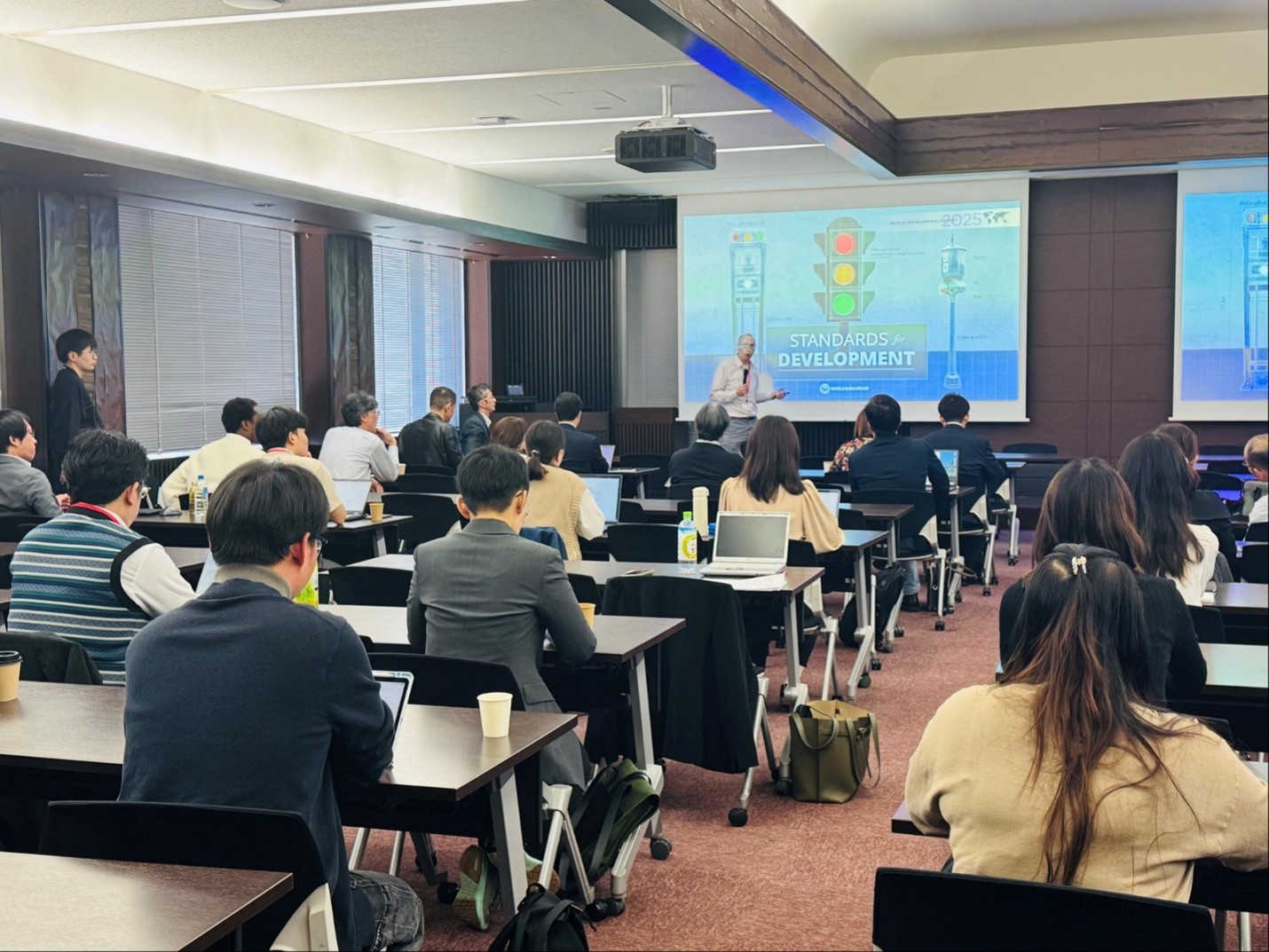
The Q&A that followed ranged from the cost-benefit calculus of compliance — mandatory standards impose real costs that can outweigh gains for smaller producers — to the outsized influence of private associations and large firms in shaping the standards that nominally apply to everyone. Participants noted that Fair Trade's limited commercial impact shows certification without genuine buyer commitment rarely improves farmer incomes, and that having domestic testing laboratories means little if importing jurisdictions only accept results from within their own borders.
A Conversation Worth Having
Taken together, the three days of engagement in Tokyo produced a rich convergence of perspectives across academia, government, and development practice — the kind of encounter that the IED is designed to foster, bringing together the best ideas from around the world and making development knowledge more accessible, inclusive, and actionable. Japan offered both a case study and a mirror: a country that built postwar prosperity in part through the disciplined embrace of quality standards, now grappling with the same questions of inclusion, power, and evidence that the WDR 2025 puts at the center of the global conversation. The seriousness with which Japan's development community engaged those questions across four very different forums suggests that the conversation is far from over — and that it is exactly the right moment to be having it.
To learn more, download the World Development Report 2025.
Related Content