 October 26, 2026 - October 27, 2026
 Palermo, Italy
Africa Growth and Opportunity: Research in Action Conference 2026
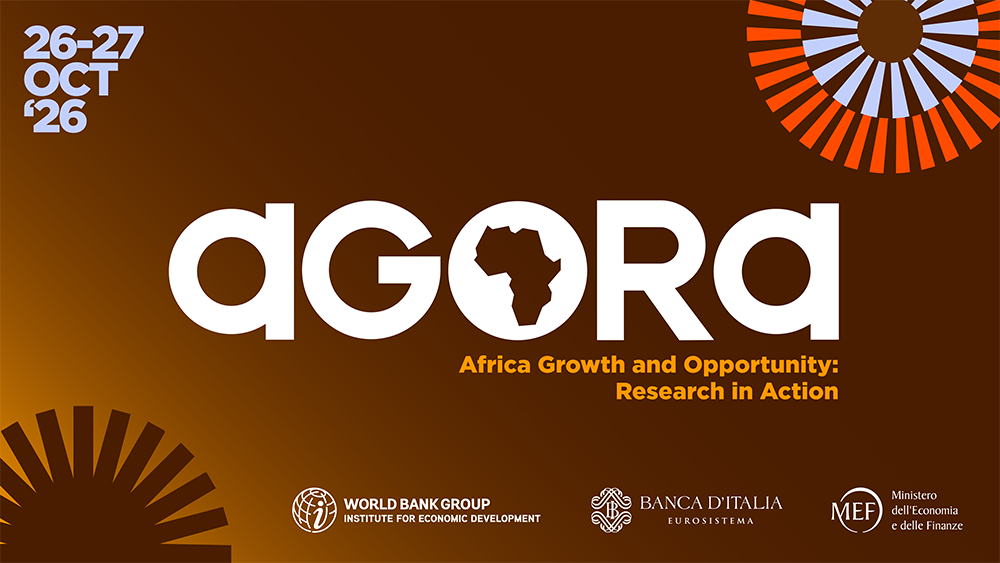
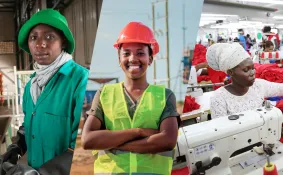
How can investment in skills be translated into jobs that drive growth at scale in Africa? The Africa Growth and Opportunity: Research in Action 2026 Conference (AGORA 26) will explore how better alignment between skills, workforce development, and entrepreneurship and firm demand can support Africa’s growth and job creation.
Co-hosted by the World Bank Group Institute for Economic Development with the Bank of Italy, Italy’s Ministry of Economy and Finance, and African partners, AGORA 26 will connect policymakers, researchers, and private sector leaders to turn ideas into action. The conference will bridge research, policy dialogue, and implementation, with a focus on translating growth strategies into jobs.
Building on the AGORA 2025 conference—which explored the foundational role of physical infrastructure and regulatory reforms in energy and agriculture—AGORA 2026 will focus on the next step: turning investments in skills into jobs and growth. As investment in energy, agribusiness, and value chains expands, the challenge is ensuring these translate into firm productivity and sustained employment.
Stay tuned for updates and follow the online conversation using #AGORA26.
All times listed below are in Central European Time (CET).
| Day 1 – October 26 | |
| 09:00–09:30 | Opening and Welcome Remarks |
| 09:30– 10:30 | Mattei Lecture - The Africa Job Challenge This opening keynote address will set the tone for the conference and establish the scale and urgency of Africa’s employment and growth challenge. The keynote will explore why this is a generational opportunity that demands bold, evidence-backed action on skills, talent, and job creation, with energy and agribusiness as two of the most powerful engines to drive growth. |
| 10:30– 11:00 | Coffee Break |
| 11:00– 12:30 | Closing the Skills Gap for Firms This panel will examine how African and global employers define the skills they need, where education and training systems fall short, and how workforce development and young people’s aspirations can be better aligned with a rapidly changing labor market. The discussion will focus on energy and agribusiness, two sectors in which closing the skills gap is especially urgent and consequential for Africa’s growth. |
| 12:30– 14:00 | Lunch Break |
| 14:00– 15:00 | Skills, Jobs, and Labor Market Change Drawing on decades of pathbreaking research, Nobel laureate Professor David Card will reflect on what modern labor economics has taught us about how labor markets work, how skills and opportunities are shaped, and how institutions and policy affect workers and firms. Looking across some of the major transformations reshaping labor markets, the keynote will offer a broad perspective on the forces behind employment, mobility, and economic opportunity. These insights will offer a valuable lens through which the AGORA community can reflect on the challenges and opportunities facing developing economies, including Africa’s own path toward stronger growth, better jobs, and greater economic opportunity. |
| 15:00– 15:30 | Coffee Break |
| 15:30– 17:00 | UpSkilling the Energy Sector This panel will examine the workforce transformation demanded by Africa’s energy transition, including through investments under Mission 300. Panelists will explore how training institutions, employers, governments, and development partners can work together to build the technical skills needed to expand and sustain energy access at scale, moving from what the evidence tells us to what countries and firms are doing in practice . |
| 15:30– 17:00 | AgriConnect and the Power of Aggregation How can investments in skills translate into firm growth, higher productivity, and jobs? In agrifood systems, this transformation often happens through producer organizations, cooperatives, aggregators, and small and medium-sized enterprises that connect farmers with buyers, services, technology, and finance. This session will examine aggregation as an organizational capability, not simply a market-access mechanism. It will explore how governance, management, quality control, negotiation, digital record-keeping, and leadership shape the success of aggregation models, enabling them to become resilient, investable, technology-enabled enterprises that drive productivity and jobs. |
| 17:00– 18:00 | From Knowledge to Innovation and Job Creation Through a series of ignite talks, this session will bridge research and practice by highlighting examples of how innovation in education, agribusiness, and technology is already creating jobs and economic opportunity across Africa. The presentations will showcase scalable, home-grown solutions that are delivering tangible results and demonstrate how these approaches can be adapted and replicated in diverse contexts. |
| Day 2 – October 27 | |
| 08:30– 09:00 | Opening Remarks |
| 09:00– 10:00 | Private Sector Leadership in Africa's Skills Revolution This fireside chat brings together Ousmane Dione, World Bank Group Vice President for the Middle East, North Africa, Afghanistan and Pakistan (MENAAP), and entrepreneur Nora Magero, Co-Founder & CEO of Drop Access Limited, for a fast-paced conversation on private sector leadership in the Africa skills revolution. Drawing on perspectives from both institutional strategy and frontline enterprise building, the conversation will explore how employer-driven approaches to training, hiring, and youth employment can deliver impact at scale – and what it takes to move beyond one-time successes toward scalable solutions. |
| 10:00– 10:30 | Coffee Break |
| 10:30– 12:00 | UpSkilling Agriculture This session will explore how digital innovation is transforming African agriculture and the implications for skills development, training systems, and institutional capacity. Drawing on AgriConnect country experiences and frontier research, the discussion will examine how evidence can inform practical solutions to support more productive, inclusive, and resilient agrifood systems. |
| 10:30– 12:00 | Powering Productive Economies through Mission 300 This session will examine the link between Mission 300's expansion of electricity access and its potential to drive productive economic activity, enterprise growth, and jobs. Bringing together government, research, and private sector perspectives, the discussion will explore what it takes — from policy and infrastructure delivery to human capital and grid reliability — to turn expanded access into genuine productive use. |
| 12:00– 13:00 | The Future of Economic Research for Policy Through a series of ignite talks, this session brings the next generation of African development economists to the forefront. Presenters will showcase their frontier research and emerging agendas on skills, energy, and agribusiness directly to policymakers and practitioners, bridging the gap between cutting-edge research and on-the-ground decision-making. |
| 13:00– 14:30 | Lunch Break |
| 14:30– 16:00 | Skills, Jobs, and the Path to Opportunity Jobs are a key pathway through which economic growth improves lives, but that link is neither automatic nor guaranteed. This session will explore how growth translates into productive opportunities, better jobs, and improved worker outcomes. Drawing on the emerging framework of the World Bank’s World Development Report 2027 on jobs, the discussion will bring together World Bank operational experience and perspectives from government and the private sector to examine what enables workers to access and progress toward better opportunities, how firms foster productivity and learning, and how policies and institutions can support stronger employment trajectories and greater worker welfare. |
| 14:30– 16:00 | Italian Ministry of Economy and Finance (MEF) Dialogues This session, led by the Italian Ministry of Economy and Finance, will spotlight two initiatives that reflect Italy’s Mattei Plan vision: Resilient and Inclusive Supply Chain Enhancement for Green Energy Transition and A Roadmap to Connect Africa to Europe for Clean Energy Production. Together, these initiatives capture the Plan’s dual focus on continental integration and country-led transitions that attract investment, build resilience, and drive growth. |
| 16:00– 16:30 | Coffee Break |
| 16:30– 17:00 | Agree to Disagree This session will aim to break from the panel format with the moderator opening the floor to the full plenary for a frank conversation on what emerged — and what didn't — over the two days. It will be a an opportunity to spot the controversies, unresolved disagreements, and open questions that conference panels tend to smooth over or run out of time to address. This plenary discussion will give voice to what the audience sensed but didn't get to say, and point to the debates worth carrying into AGORA in Motion's coming year of work. |
| 17:00– 18:15 | Looking Ahead with AGORA in Motion The closing panel will respond to the questions and tensions raised across the two days — including in the plenary discussion — and will turn to what comes next. Panelists will set out concrete priorities for AGORA in Motion's coming year: the research gaps to fill, the partnerships to build, and the steps needed to turn Africa's talent opportunity into reality, with energy and agribusiness as the sectors where progress is most urgent. |
| 18:15– 18:30 | Closing Remarks |
| Keynote Speakers | |
 | Mattei Lecture – The Africa Job Challenge Monica Musenero Masanza |
 | Skills, Jobs, and Labor Market Change David Card |
| Speakers | |
 | Femi Adeyemo |
 | Hardi Ahmed |
 | Alloysius Attah Co-founder and CEO, Farmerline |
 | Lucy Blackburn |
 | Veronica Bolton Smith Founder & CEO, The Critical Minerals Africa Group |
 | Andrea Brandolini |
 | Mario Bruni |
 | Moderator |
 | Gero Carletto |
 | Simona Caselli President, Granlatte |
 | Madalitso Chipekwe Daka Co-founder and Executive Director, ACADES |
 | Ousmane Dione |
 | Karim El Aynaoui |
 | Anita Guelfi Head of Technical Secretariat of the Minister, Italian Ministry of Economy and Finance |
 | Chakib Jenane |
 | Peter Kanda |
 | Abbi Kedir |
 | Somik Lall |
 | Maganga Mabula Founder & CEO, Afya Ya Mnyama Digital Limited |
 | Karen Macours |
 | Norah Magero |
 | Yselle Malah-Kuete |
 | David McKenzie |
 | Mohamed Manssouri Assistant Director-General and Director of the FAO Investment Centre |
 | Augustine Mayabi Deputy Director, State Department for Youth Affairs and Creative Economy, Kenyan Government |
 | Regean Mugume |
 | Mohamed Nejib Ben Saad |
 | Muthoni Nganga |
 | Jehiel Oliver |
 | Alix Peterson Zwane |
 | Josefina Posadas Social Policy Practice Manager, World Bank Group |
 | Martin Raiser |
 | Frederik Rengers |
 | Noureini Sayouti Research Scientist, Innovations for Poverty Action |
 | Norbert Schady |
 | Eseosa Joy Sowemimo |
 | Tavneet Suri |
 | Namrata Thapar |
 | Francesca Utili Director General, Ministry of Economy and Finance |
 | Francesco Vona |
AGORA 26 discussions will be structured around three central questions:
How can the supply of skills respond to demands from firms?
Firms see shortages in technical, digital, and managerial skills, while graduates lack matching competences required for roles. AGORA 26 will examine approaches that strengthen this alignment, including sector-linked training models (e.g. in energy and agri-business) and partnerships with industry.
How can countries expand job opportunity and productivity in energy and agribusiness?
Africa’s working-age population is projected to grow by over 450 million by 2040, making job creation and talent boosting a central development challenge. Energy, agrifood value chains, and related services are key sectors because of their high potential for job creation. The Global Skills Partnership also provides a framework for linking training, and domestic job creation, connecting African countries with partners such as Italy and others.
How will technological change reshape jobs and firms?
AI and data are changing production processes and skill requirements. These shifts can increase productivity while creating new divides between firms and workers that can adapt and those that cannot. AGORA 26 will explore how countries can build capabilities to respond to these changes.
Launched in 2025, AGORA is the flagship platform of the World Bank Group Institute for Economic Development for advancing development in Africa through evidence-based dialogue and cross-regional collaboration. Named after the ancient Greek public forum, AGORA is designed as an open arena where African and European institutions set the agenda together, ensuring balanced ownership and accountability.
AGORA addresses a structural gap in development dialogue: most Africa-focused conferences are either African-led in Africa or donor-led in the Global North, with little joint leadership. AGORA seeks to break that pattern, creating a recurring instrument for dialogue that is tied to implementation partners on both continents.
Designed for Long-Term Impact
AGORA is a standing instrument with year-round engagement, AGORA in Motion, to track progress, respond to emerging challenges, and deepen partnerships. By combining the convening power of the World Bank Group and African institutions with the political momentum of Italy’s Mattei Plan, AGORA turns policy into tangible results for Africa’s future.